Written by Annelies Judson, a trained teacher with a passion for maths and science. Annelies also writes children's poetry and picture books. Article published January 2026.
This Spotlight is part of a series highlighting environmental contexts for mathematics and statistics learning in Aotearoa primary and intermediate schools, using the new curriculum. Links to related mathematics stories and resources are included throughout and at the end.
Geometry in the Garden
Many schools and kura have access to either a school or community garden, along with natural outdoor spaces that can be used to engage ākonga with hands-on learning. Some students will also have a garden or growing space in their homes or neighbourhoods, which helps connect learning with whānau and students' prior knowledge.
Gardens and nature provide an excellent context for geometry learning. Creating or maintaining a garden offers a great opportunity for both whole-school projects, and smaller class or group projects that can help link mathematics learning to other curriculum areas.
Getting Started
The lessons and activities that can be achieved will depend on your school’s current or desired garden set up, and level of accessibility. The gardens might be focused on growing kai for the school and community, or they could also include food and habitat for other animals, such as lizards, moths, butterflies and birds.
Here are some resources and programmes to get you started with this context:
.webp)
National programmes such as Enviroschools, Para Kore and Garden to Table have resources and experienced educators who work with schools to support gardening. You can also search our Providers catalogue to find organisations in your local area.
Backyard Biodiversity is an engaging website that includes information about both edible gardens and native plants and insects.
Science Learning Hub has a huge range of resources to support teachers, with a Gardens collection you can explore.
Creating a School Garden is a collection of resources and ideas from Southland Community Nursery, including both edible and native gardens.
Kaiako may also be interested in our Compost Calculations Spotlight, which covers measurement and algebra, and includes activities related to school gardens.
Mathematics Curriculum Links
The mathematics and statistics curriculum has recently been updated for Yrs 0 - 8, with the final updated curriculum document released in October 2025. The new curriculum for Yrs 9 - 10 is also available, but this Spotlight article focuses mainly on learning for Yrs 0 - 8.
The teaching sequences for Geometry in Phases 1-3 are linked here:
Phase 1 (Years 1-3) Phase 2 (Years 4-6) Phase 3 (Years 7 - 8)
Geometry is divided into three areas: Shapes, Spatial Reasoning and Pathways.
The activities below incorporate all three areas, but do not incorporate every learning outcome. There are also aspects of Measurement and Algebra incorporated into these activities and clear links to other curriculum areas such as Science.
Constructing a New Garden - Real or Imaginary!
These activities can be used both to describe an existing garden and to plan for a new one. They are grouped according to the learning areas within geometry and ordered according to difficulty.
Below these activities is a suggested unit for a whole class or syndicate that integrates other curriculum areas and encourages students to plan and carry out actions.
Shapes
Note that many aspects of “Shapes” are also incorporated into “Spatial Reasoning”.
Discuss the objects within the garden:
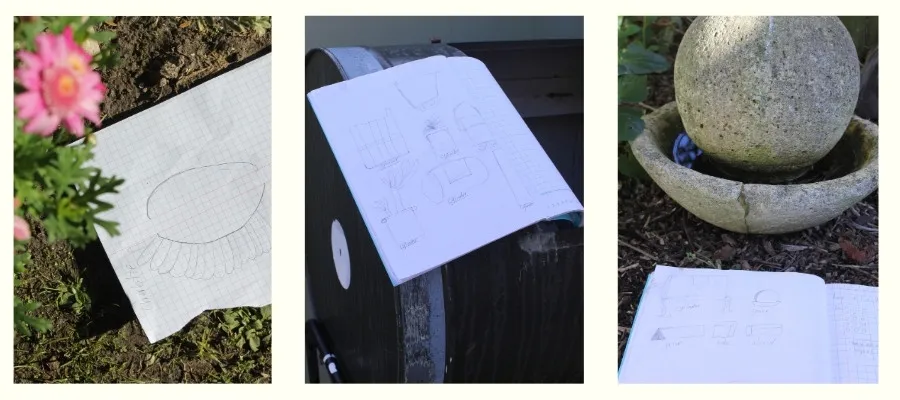
- Talk about the shapes of the objects such as sheds, planter boxes, water tanks.
- Discuss the difference between the 2D and 3D shapes that you can see.
- Look at garden structures online and discuss the shapes they are made of.
Describe the flora and fauna:
- Identify the shapes they see in the animals and plants in the garden (you could use this shapes scavenger hunt from Kids Greening Taupō).
- Create shape art, where students represent a chosen plant using only geometric shapes, either pre-cut or drawn themselves.
- Describe characteristics of plants using shape vocabulary. e.g. round, straight, corners.
- Use classroom shape resources (e.g. shape tiles, geoboards, rubber band boards) to create images of plants, flowers and leaves from the school grounds.
- Identify rotational or reflective symmetry in flowers, leaves and plants in the school grounds, for example by taking photos or sketching.
- Describe characteristics of garden objects (e.g. climbing frames, raised beds) using shape vocabulary. e.g. cube, pyramid.
You can also integrate aspects of Measurement within many of these activities, such as when analysing, or planning for, the practical aspects of a garden:
- Work out the volume of materials within an existing garden, or that would be required for a new garden. e.g. soil, compost, bark
- Consider the shapes and sizes of the different garden features, and calculate what would be needed to construct them. e.g. how much wood to construct a planter box?
- Write the dimensions of various features of the garden (e.g. paths) so the plan would be able to be used by someone else to construct the garden.
Spatial Reasoning
Describe features of your current garden, or an ideal garden:
- Talk about the 2D shapes that make up the faces of the 3D objects within the garden.
- Look at a birds’ eye view of the garden and discuss the shapes you can see, or create an imaginary birds’ eye view of a dream garden.
Draw a representation of the garden:
- Draw a plan on an existing map of the school.
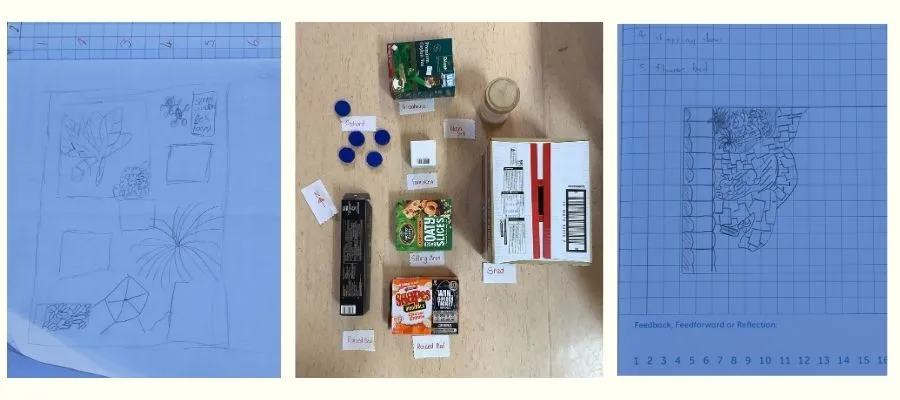
- Use pre-cut or pre-drawn geometric shapes, laying them out on a table or the floor. Older or more capable students can draw their own shapes to lay out.
- Use squared paper to scaffold students to draw the map by hand, or use the squares to create a map with a specific ratio (this also links to algebra).
- Use tools such as rulers, compasses and protractors to draw and position the objects.
Create a scale model of the garden:
- Use toys or cardboard models to represent the scale, and ask students to create the plan using existing objects within the classroom, or a selection of recycled boxes etc.
- Draw nets and create models of the different garden features. e.g. sheds, water tanks
Pathways
Use spatial vocabulary to describe the features of the garden:
- Describe features within the garden using positional language. e.g. behind, beside
- Describe the relationship of the garden to other features in the school. e.g. to the left of the fence, on the north side of the field
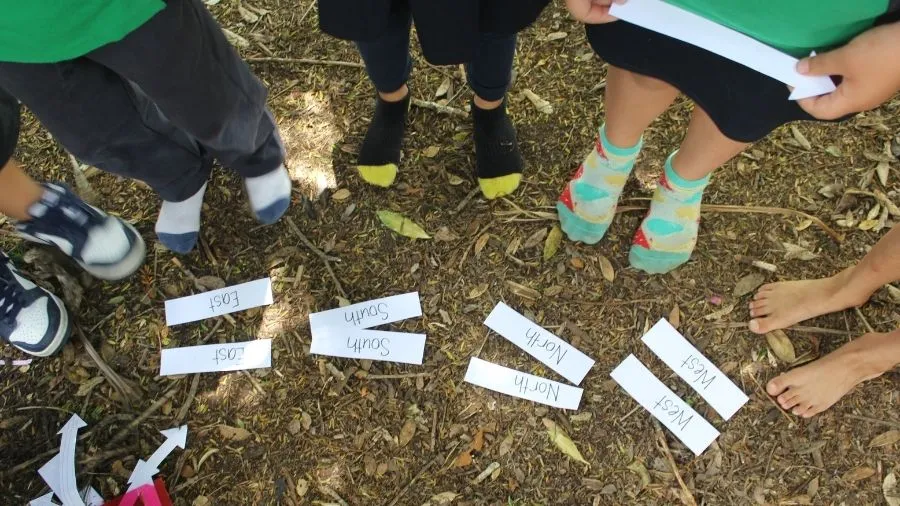
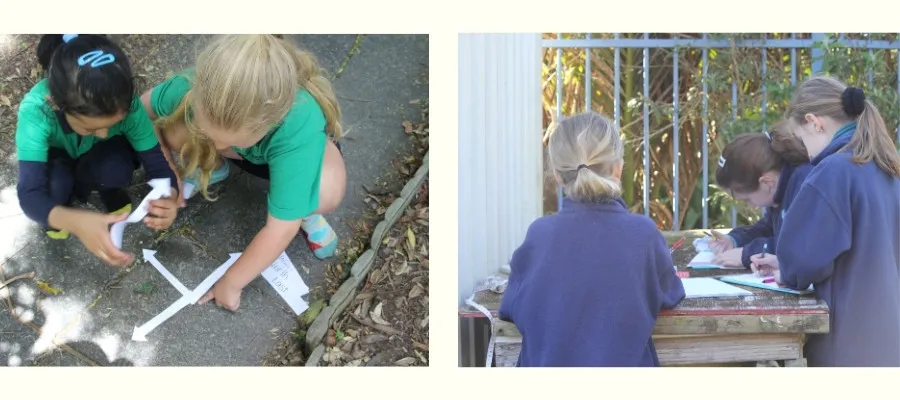
- Use compass points to talk about where the garden is, or where different features are within the garden.
- Discuss how much sun the different parts of the garden will get based on its location in relation to the sun’s path (this also links with the Science curriculum).
Describe the garden to someone else:
- Give a virtual or video tour of the garden, using words to explain the path you would take and the turns you would make.
- Write an explanation for visitors to the school of how to get to the garden.
- Print or create a map of the garden using grid paper and use co-ordinates to locate features in the garden.
Our New Garden: Class or Syndicate Unit
If your school is looking to update, change or create a garden, then you have an ideal situation for a learning experience that has a real-world outcome. Alternatively, you could set a creative challenge, where students get a chance to imagine what the school garden could look like in the future. You could also do a little of both, and refresh part or all of your current gardens or grounds.
Before starting this unit, it may be useful to discuss or investigate with ākonga the purpose and requirements of gardens e.g. raised beds, paths, diversity and source of plants, water supply, sheds etc. Students can investigate and plan a school garden, community garden, or a home garden. Contexts could include growing kai, rongoā, habitats and food for animals, or outdoor classroom and mindfulness spaces.
Useful resources to help support this inquiry include:
Tools for Environmental Action from the Department of Conservation
Earth Dreamers inquiry: Feeding Our Community (pg 16 - 19)
The unit could progress as follows:
- Students investigate the current garden or space, including the dimensions, amount of sunlight, and existing features.
- Research possible options that will fit practically within the space. For extra extension, you could:
- Give students a budget (real or imaginary!)
- Ask students to survey stakeholders about their requirements e.g. school caretaker, Board of Trustees, students. This links nicely with Statistics and Social Sciences learning.
- Invite a landscape architect, local gardener, or rongoā expert to speak to students.
- Create scale models and maps of the proposed changes. This learning can be linked to outdoor education and geography concepts.
- Create a “sales pitch” or roadshow in a classroom or other space within the school. Students can write or speak persuasively about the importance of a garden, why their option is the best, the benefits for the school or community etc. Learning can be linked to English, Health, Science, Technology and The Arts.
- Take Action: Choose a plan (or aspects of the plan) that you can achieve. There is an opportunity to link to Social Sciences in terms of public spaces, diverse perspectives, negotiating, compromising and reaching an agreement. Then carry out the plan!
- Celebrate: Invite people to an opening ceremony or other event for your garden. You could send out invitations with maps, create a marketing video etc. This activity links nicely with The Arts and English. If you are unable to make changes to your grounds, this can be an opportunity for students to promote an existing garden.
Stories and Related Resources
Building a māra kai at Ōtorohanga Primary School
Hard mahi and money enables rich and living curriculum
Maeroa Intermediate takes maths outdoors for a real-world challenge, Enviroschools story about the creation of a native plant nursery using geometry and measurement skills and knowledge.
In the Garden maths resource on Tāhūrangi includes geometry learning related to translations, reflections and rotations on plane shapes in a garden context.
Honeycomb maths resources on Tāhūrangi includes geometry learning related to 2D and 3D shapes alongside research and learning about honeybees.
Maths Outdoor Activities from Education Outdoors NZ has a range of printable activities.
The Future of Growing Kai by Arihia Latham, School Journal 2023 (Level 2) provides an opportunity to support literacy and mātauranga Māori within this learning context.
Kiwi Kai online tool is designed for year 5–8 students, introducing them to sustainability issues encountered in farming and food growing.
The Nature Activity Book by Rachel Haydon includes maths activities related to shapes, patterns, symmetry and angles.
Earth Dreamers, for ākonga in Years 7 - 8 and linked to Te Ao Tangata | Social Sciences curriculum, with an inquiry focus that can easily be adapted for younger or older ākonga. We highly recommend this resource, based around mātauranga Māori and our local Aoteaora context, with links to engaging questions, videos, articles and books for topics such as soil, circular economies, regenerative farming, climate change and our connection with nature.
You may also like to read our related Spotlight articles with links to the updated mathematics and statistics curriculum:
Compost Calculations: Algebra and Measurement in Action
Exploring Biodiversity through Statistics Investigations
Measuring the Mighty: Maths Adventures in Kauri Education
Image Acknowledgements
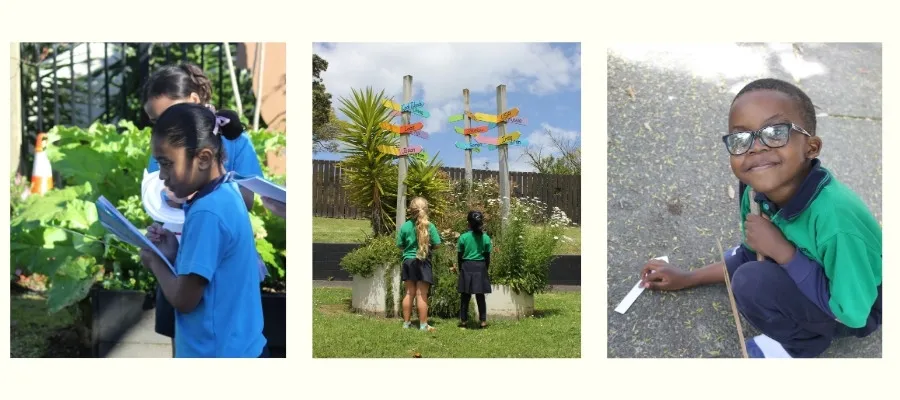
Huge thanks to Annelies Judson for contributing the images used in this article. All images are used with permission from the young people and schools involved.
Author Bio
Annelies Judson is a trained teacher with a passion for maths and science. She also writes children's poetry and picture books. You can find out more about her at anneliesjudson.wordpress.com, or contact her at annelies.judson.writer@gmail.com.